
EYE AI: Bridging Design and Diagnosis
EYE AI: Bridging Design and Diagnosis
Designing intuitive dashboards and tools to support healthcare professionals in diagnosis and care.
Designing intuitive dashboards and tools to support healthcare professionals in diagnosis and care.
Role
UX/UI Designer
Role
UX/UI Designer
Platform
Web Design
Platform
Web Design
Industry
Healthcare
Industry
Healthcare
Duration
2 months
Duration
2 months
Predictive AI
Predictive AI
Human-Centered Design
Human-Centered Design
Design Systems
Design Systems
Overview
Overview
This project at Onward Technologies focused on designing a comprehensive digital solution for retina specialists and technicians who faced fragmented workflows across patient data, image analysis, and diagnosis.
During my time at Onward, I worked as a Product & Interaction Designer to design a centralized web portal that integrated 3 core functions - patient data management, AI-assisted image analysis, and facilitated the diagnostic report generation.
The aim was to build on efficiency, accuracy, and confidence in diagnostics using a GenAI-powered platform.
This project at Onward Technologies focused on designing a comprehensive digital solution for retina specialists and technicians who faced fragmented workflows across patient data, image analysis, and diagnosis.
During my time at Onward, I worked as a Product & Interaction Designer to design a centralized web portal that integrated 3 core functions - patient data management, AI-assisted image analysis, and facilitated the diagnostic report generation.
The aim was to build on efficiency, accuracy, and confidence in diagnostics using a GenAI-powered platform.
My Role
My Role
Competitive analysis on current GenAI applications in the MedTech for viable integration.
Designing workflows to streamline data management and reduce task load for healthcare professionals.
Maintaining consistent documentation and brand alignment through evolving design stages.
Competitive analysis on current GenAI applications in the MedTech for viable integration.
Designing workflows to streamline data management and reduce task load for healthcare professionals.
Maintaining consistent documentation and brand alignment through evolving design stages.
Problem Statement
Problem Statement
How can a technology-based solution enable retina specialists and technicians to efficiently manage patient data, analyze retinal imagery, and deliver accurate diagnostics—while maintaining usability, clarity, and trust in high-stakes medical environments?
How can a technology-based solution enable retina specialists and technicians to efficiently manage patient data, analyze retinal imagery, and deliver accurate diagnostics—while maintaining usability, clarity, and trust in high-stakes medical environments?
Approach
Approach

Research Process
Research Process
To ground our solution in reality, we mapped AI's role within retinopathy diagnostics. Our domain scan revealed how AI supports image analysis, patient data review, predictive modeling, and task automation—yet also exposed key gaps in workflow efficiency, clinician trust, and the practical meaning of “usable” AI in clinical environments.
These insights informed our strategic direction and insights into user pain points, needs, & expectations guiding feature prioritization that supports the user’s workflow rather than replacing it entirely.
To ground our solution in reality, we mapped AI's role within retinopathy diagnostics. Our domain scan revealed how AI supports image analysis, patient data review, predictive modeling, and task automation—yet also exposed key gaps in workflow efficiency, clinician trust, and the practical meaning of “usable” AI in clinical environments.
These insights informed our strategic direction and insights into user pain points, needs, & expectations guiding feature prioritization that supports the user’s workflow rather than replacing it entirely.

User Research, Key Insights & Journey Mapping
User Research, Key Insights & Journey Mapping


Early Designs
Early Designs
Early iterations focused on aligning the user flow and overall experience with project goals. Through multiple design cycles - integrating developer feedback and stakeholder reviews - we crafted the solution to strengthen both business objectives and the end-user experience.
Early iterations focused on aligning the user flow and overall experience with project goals. Through multiple design cycles - integrating developer feedback and stakeholder reviews - we crafted the solution to strengthen both business objectives and the end-user experience.

AI Model
AI Model
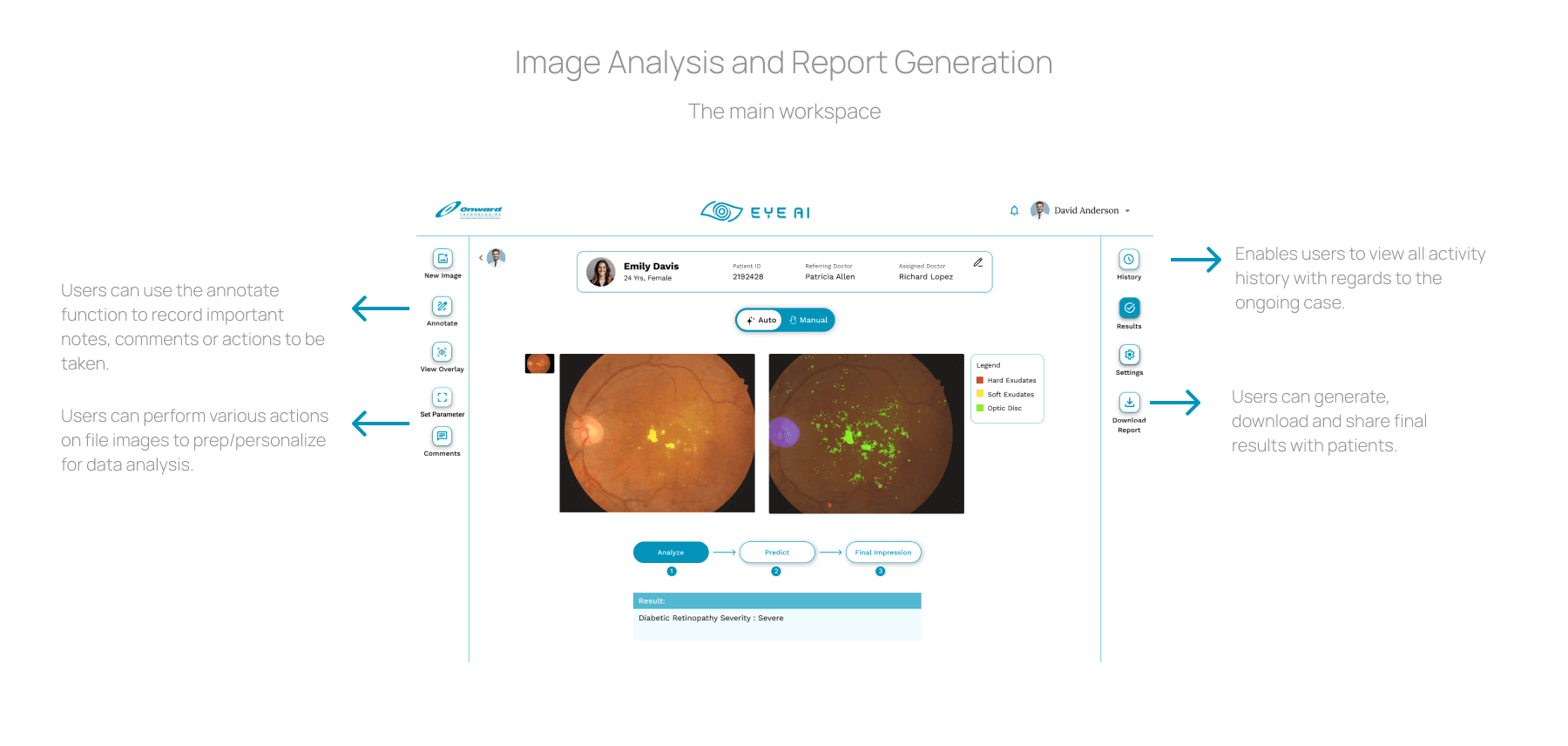
The AI-powered retinal analysis system processes uploaded fundus images through a deep learning pipeline for real-time disease detection. Images are first preprocessed and passed into a ResNet50-based model that extracts key retinal features and performs multi-task classification for diabetic retinopathy and macular edema. The system provides immediate severity assessments, generates visual overlays to explain predictions, and allows clinicians to confirm results for final reporting. All analyses are securely stored, enabling patient history tracking and streamlined diagnostic workflows.
The AI-powered retinal analysis system processes uploaded fundus images through a deep learning pipeline for real-time disease detection. Images are first preprocessed and passed into a ResNet50-based model that extracts key retinal features and performs multi-task classification for diabetic retinopathy and macular edema. The system provides immediate severity assessments, generates visual overlays to explain predictions, and allows clinicians to confirm results for final reporting. All analyses are securely stored, enabling patient history tracking and streamlined diagnostic workflows.

Final Designs & Key Features
Final Designs & Key Features
Throughout the process, the aim focused on:
Reducing diagnostic time by 40% through real-time AI-assisted retinal image analysis, cutting manual effort and evaluation from 10 mins to under 4 mins.
Improving diagnostic accuracy by 15%, supporting retina specialists in early detection of diabetic retinopathy and Macular Edema with multi-task deep learning.
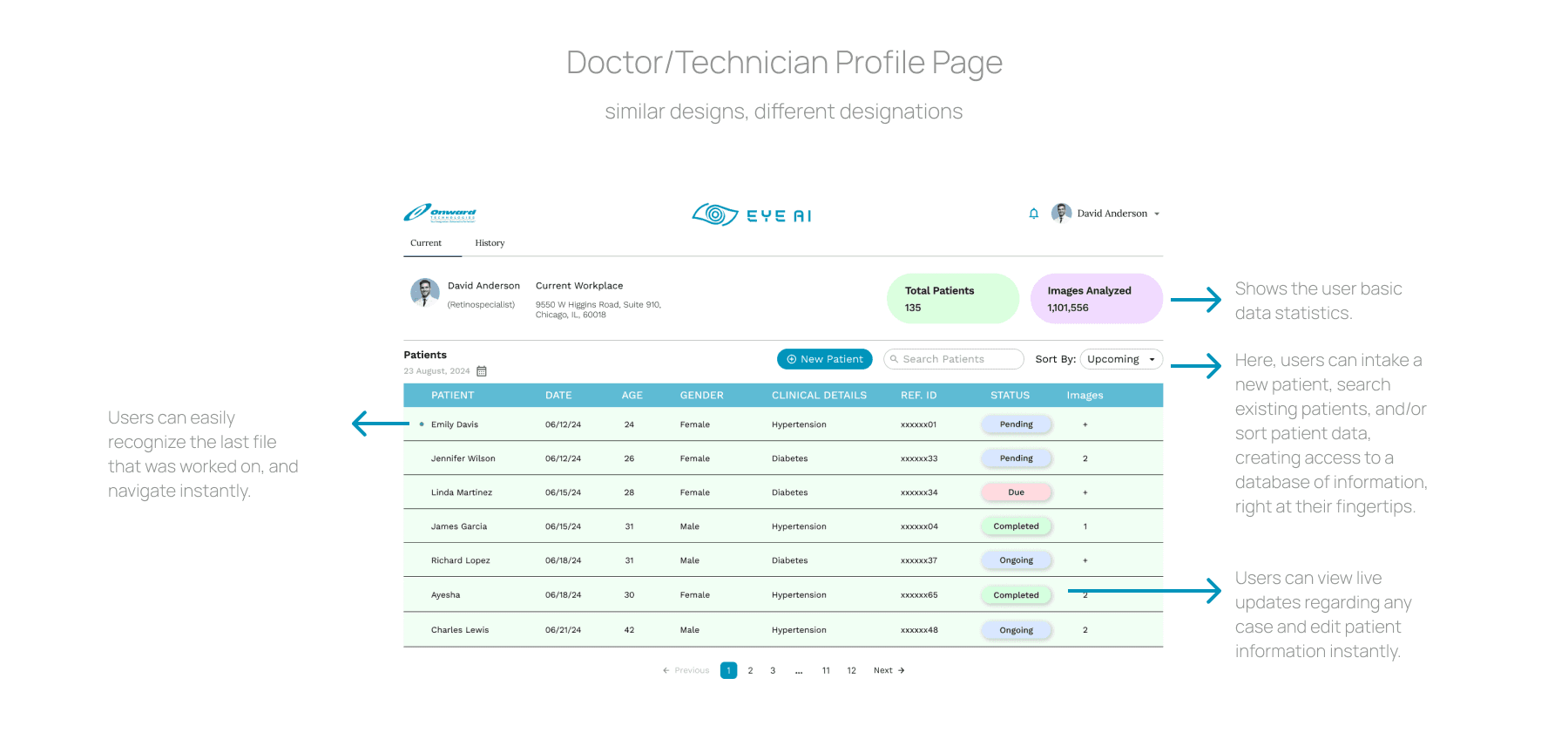
Enhancing clinical efficiency & adoption by providing secure history tracking, automated PDF reporting, and explainable visual overlays.
Throughout the process, the aim focused on:
Reducing diagnostic time by 40% through real-time AI-assisted retinal image analysis, cutting manual effort and evaluation from 10 mins to under 4 mins.
Improving diagnostic accuracy by 15%, supporting retina specialists in early detection of diabetic retinopathy and Macular Edema with multi-task deep learning.
Enhancing clinical efficiency & adoption by providing secure history tracking, automated PDF reporting, and explainable visual overlays.


Design
Design


What I Took Away
What I Took Away
🛠 Bridging AI & UX – With in tight deadlines, I learned how to integrate a multi-task deep learning model into a user-friendly, clinician-focused web interface.
🛠 Bridging AI & UX – With in tight deadlines, I learned how to integrate a multi-task deep learning model into a user-friendly, clinician-focused web interface.
⚡ Iterative Problem-Solving – I realized that small improvements - like visual overlays and report automation - had a huge impact on adoption and real-world efficiency.
⚡ Iterative Problem-Solving – I realized that small improvements - like visual overlays and report automation - had a huge impact on adoption and real-world efficiency.
🤝 Collaboration & Scalability – Learned to balance visual quality with performance, knowing when to push for better design and when to prioritize scalability.
🤝 Collaboration & Scalability – Learned to balance visual quality with performance, knowing when to push for better design and when to prioritize scalability.
Copyright © Eshani Somwanshi 2026
Copyright © Eshani Somwanshi 2026
Copyright © Eshani Somwanshi 2026